.webp)
Alarmed Storage Units: What Individual Unit Alarms Actually Protect Against
Alarmed Storage Units: What "Individual Unit Alarms" Actually Protect Against
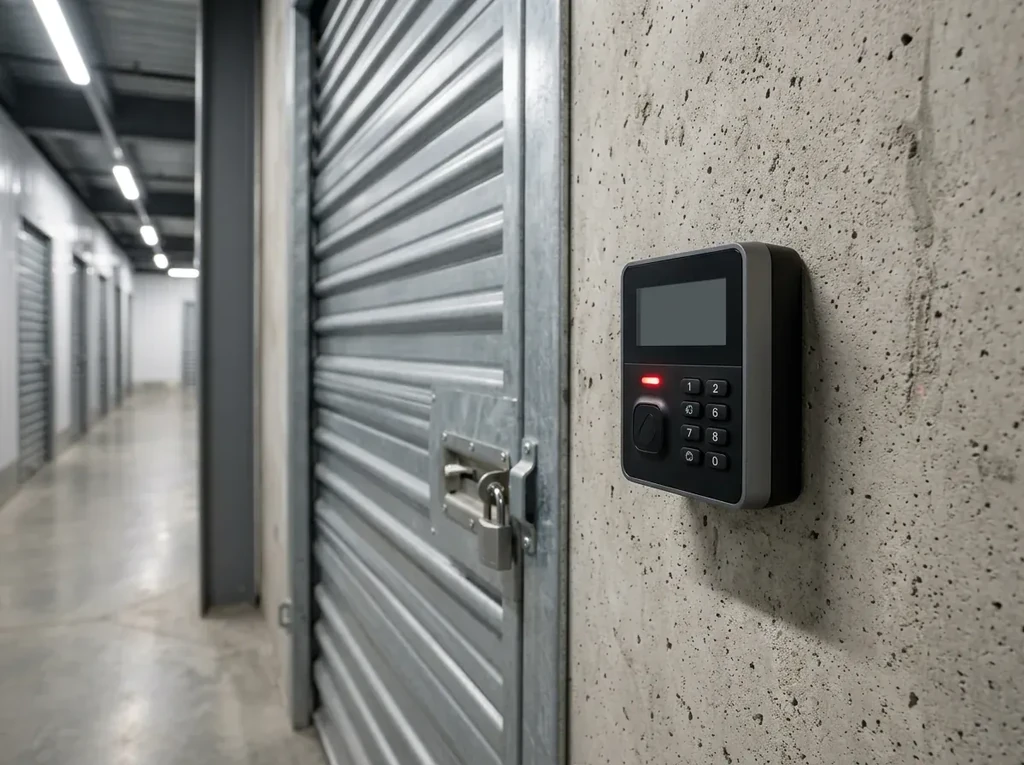
Storage unit alarms come up often when renters are comparing facilities, but the term gets used loosely enough that it's worth unpacking what it actually means. An individual unit alarm is a sensor mounted directly on a specific unit's door or latch, separate from any perimeter or building-wide system. When that door opens without a valid entry code or outside of authorized hours, the alarm triggers. That's the core function, and understanding it helps you judge whether alarmed units genuinely address your concerns.
How Individual Unit Alarms Work
Most individual unit alarm systems use a door contact sensor or a latch-based sensor. When the door is opened, the circuit breaks and the alarm activates, typically sounding locally at the unit and sending an alert to facility management or a monitoring service. Some systems require a PIN to be entered at a keypad near the unit before opening; others tie into the facility's main access control system so that your gate code also disarms your specific unit.
The key distinction is that these alarms respond to an opened door, not to someone cutting through a wall or ceiling. They're designed to catch the most common scenario: someone attempting to open a unit they don't have authorization to enter.
What They Actually Help Protect Against
Individual unit alarms are most effective at deterring opportunistic access. If someone walks down a corridor and tries door handles, an alarm on each unit raises the risk of detection significantly. That deterrence effect is real. Facilities that advertise alarmed units are signaling that unauthorized access won't go unnoticed, which discourages casual attempts.
They also create an audit trail. When an alarm triggers, the time and unit number are logged. That record can be useful if a renter reports a concern, because management can cross-reference the log against access records to identify any anomalies.
What They Don't Cover
A door sensor won't detect someone who forces entry through the unit's side wall, cuts a lock, or tailgates through the main gate behind an authorized renter. Unit alarms work best as one layer in a broader system rather than a standalone solution. Facilities that combine alarmed units with perimeter fencing, keypad gate access, and on-site management during business hours offer more overlapping layers of deterrence than any single feature alone.
It's also worth noting that no alarm system eliminates risk entirely. Alarms reduce the likelihood of undetected unauthorized access, but they don’t prevent every possible scenario.
Questions To Ask Before You Rent
When evaluating a facility that advertises storage unit alarms, a few direct questions will tell you a lot about how the system actually functions. Ask whether the alarm is on every unit or only on select unit types. Ask whether it triggers locally, remotely, or both. Find out whether the alarm is tied to your specific access code or operates independently. And ask what happens when an alarm triggers, including whether someone responds in real time or whether it's logged for review later.
Those answers will give you a clearer picture than any marketing language. You can also review some of the most common self storage myths to separate fact from assumption before committing to a facility.
Finding a Facility That Fits Your Needs
Unit alarms are one factor among several when choosing where to store your belongings. Size, location, access hours, and the overall condition of the facility all matter too. If you're still figuring out how much space you need, A-1 Self Storage has a unit size guide that walks through common unit dimensions and what fits in each. And if you're looking at multiple markets, review the full selection of A-1 Self Storage locations to find a facility near you. Going in with specific questions about storage unit alarms and other security features puts you in a much better position to evaluate what a facility actually offers rather than what its marketing implies.